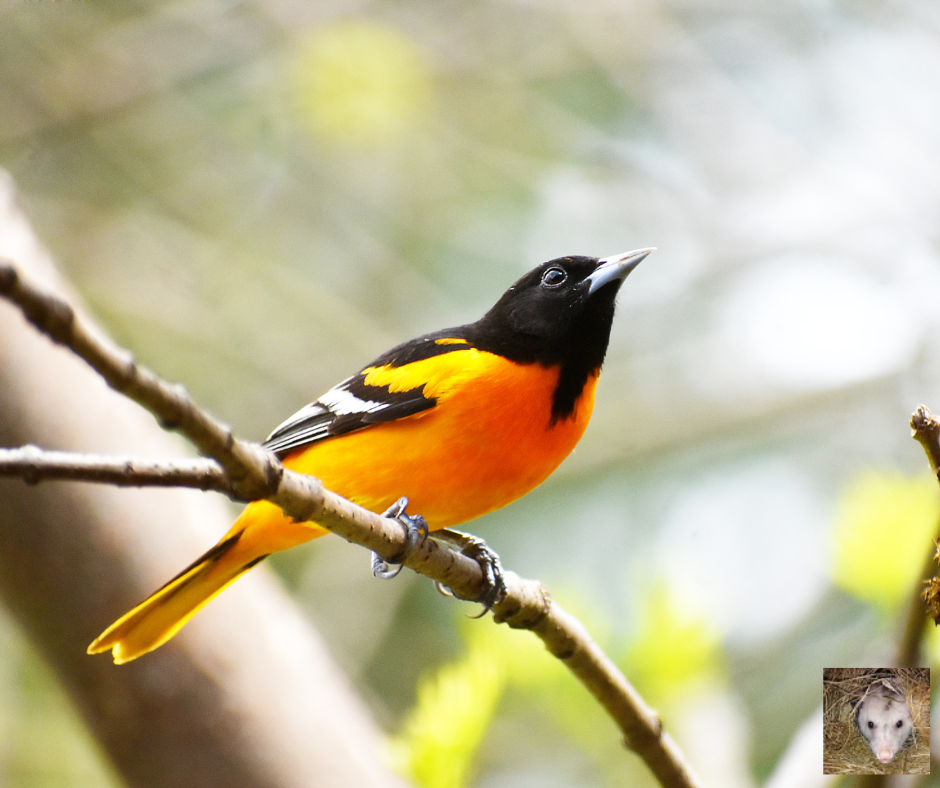
Imagine a bird so stunning that it inspired the colors of a Major League Baseball team. Meet the Baltimore Oriole, a feathered flash of brilliant orange and black that transforms ordinary backyards into scenes of tropical splendor.
Twice a year, these tiny birds—weighing less than two ounces—embark on an impressive journey. There 4,000-mile migrations to join us in the summer brings joy every spring. They spend winter in the deep south and central America and summers in the eastern us and Canada.
A Bird of Many Names and One Amazing Journey
Before we dive into their captivating world, let's clear up some confusion. The Baltimore Oriole (Icterus galbula) is actually a member of the blackbird family, not a true oriole at all. Real orioles live in the Old World, while our North American "orioles" are more closely related to meadowlarks and red-winged blackbirds.
Migration
What makes Baltimore Orioles truly extraordinary is their incredible migration. Come fall, they leave their breeding grounds across eastern North America and fly thousands of miles to spend winter in Central America, from Mexico down to Colombia. Some individuals travel as far as 4,500 miles each way, navigating by stars, magnetic fields, and geographical landmarks with a precision that would make any GPS jealous.
But here's the kicker: many of these birds return to the exact same neighborhood, sometimes even the same tree, where they nested the previous year. Scientists have documented orioles returning to within a few hundred yards of their previous nesting sites after spending months in tropical forests thousands of miles away.
The Baltimore Oriole (red and Purple) breeds and summers in much of the US. Map from Natures Way
Types of Orioles
The Baltimore is the most common oriole, but we also have Bullock’s, Hooded, and Orchard oriole. The species of oriole that you will see in your backyard depends on where you live.
The orchard oriole (Icterus spurius) is the smallest oriole species and semi-open lives in field with deciduous trees near lakes and streams. Males are more of a burnt rust or chestnut color that the Baltimore with a black head and back.
Bullock's Orioles (Icterus bullockii) are more yellow with less black on the head.
Oriole Nest Building
Baltimore orioles are basically solitary outside their mating season. The species is generally considered monogamous. They do not mate for life, often finding new mates each breeding season. Males establish their territory and attract the female by singing and chattering while hopping from perch to perch in front of her.
The female chooses a nest site within the territory defended by her mate. Baltimore Orioles often nest in American elms, maples and cottonwoods.
The female spends about a week weaving an intricate hanging pouch from plant fibers, grass, hair, and increasingly, human-made materials like string and yarn. She starts by securing long fibers to the fork of a branch, usually 20 to 30 feet high in a tall deciduous tree.
Each nest is custom-built for its location. Orioles nesting in windier areas tend to build deeper, more flexible nests, while those in more protected spots might create shallower pouches.
The finished nest is typically 4 to 5 inches deep and about 3 inches wide at the opening which helps protect the chicks from predators and weather.
From Egg to Fledgling
After the female completes her architectural masterpiece, she lays 3 to 7 pale blue or grayish eggs marked with dark scribbles and spots. These eggs are roughly the size of a grape and absolutely gorgeous.
For the next 12 to 14 days, the female does almost all the incubating, sitting patiently on her eggs while the male brings her food and stands guard nearby. Male Baltimore Orioles are devoted partners, though they don't help with nest-building or incubation. Instead, they patrol their territory, chase away intruders, and ensure their mate has a steady supply of insects and nectar.
When the chicks finally hatch, they're tiny, helpless, and completely dependent on their parents. Born naked and blind, baby orioles don't look like much at first—just pink, gaping mouths attached to fragile bodies. But they grow with astonishing speed. Both parents work tirelessly to feed the hungry brood, making dozens of trips per day to deliver caterpillars, beetles, spiders, and other protein-rich insects.
Within just 12 to 14 days, these helpless hatchlings develop their flight feathers and are ready to leave the nest. Young orioles don't look like their parents initially—juveniles and females are yellow-orange with grayish wings. Males don't develop their full adult colors until their second year, a common pattern among many songbird species.
What Do Orioles eat?
Want to turn your backyard into an oriole paradise? The good news is that Baltimore Orioles are surprisingly willing to visit well-designed feeding stations, especially during migration periods in spring and fall. Planting a variety of native species will also attract them to your yard.
The key is understanding what these birds need and when they need it. So lets talk about how to encourage them.
While many people think of them as nectar-sippers (and they do love sugar), orioles are actually accomplished insect hunters for much of the year. During breeding season, their diet consists of roughly 80% insects and only 20% fruit and nectar.
These birds are particularly fond of caterpillars, including many species that other birds won't touch. Orioles have a special technique for dealing with fuzzy caterpillars, they beat them against branches to remove the irritating hairs before swallowing them. They're also skilled at finding tent caterpillars, gypsy moth larvae, and other pest insects, making them valuable allies for gardeners and farmers.
Plants that support orioles
If you have the space for trees oaks, birch, and willows support caterpillars and provide nesting sites. Trees and shrubs with dark-colored fruits, like black cherry, red mulberry, serviceberry, raspberries, and blackberries, are particularly attractive.
Nectar-rich flowers such as trumpet vine, bee balm, blazing star, Columbine and cardinal flowers. Orioles have specially adapted tongues with brushy tips that help them lap up nectar more efficiently. Also, consider native vines and flowers that provide nectar and a place to perch.
The Baltimore Oriole transforms your backyard into a beautiful tropical scene. Learn all about orioles and how to attract them to your yard.
Providing Feeders
Timing is everything with orioles. In most areas, they arrive in late April or early May, just as trees are leafing out and flowering. This is when you want to have your oriole buffet ready and waiting.
My favorite feeder is the Kettle Moraine Recycled Oriole Fruit Feeder
The classic oriole feeder is designed for nectar, similar to hummingbird feeders but with larger perches and orange coloring. You can make your own nectar by mixing one part white sugar with four parts water—do not use artificial coloring. You can also buy nectar. Ill have links below. Make sure you clean nectar feeders on a regular basis.
Fresh or dried fruits are oriole magnets—try orange halves stuck on spikes or apple slices. Stay away from grape jelly!
Don't forget about protein, especially during breeding season. Mealworms, either live or dried, can be irresistible to orioles feeding growing chicks. Some people also offer small pieces of suet or even peanut butter, though these should be used sparingly in hot weather.
Location matters as much as menu. Orioles prefer feeding stations that are somewhat elevated and offer nearby perching spots. They're more cautious than many backyard birds and like to survey the area before committing to a landing. Placing feeders near trees or large shrubs gives them the security they crave.
Water features can be just as attractive as food. Orioles love to bathe and drink, and the sound of moving water often draws them in from considerable distances. A simple dripping water feature or shallow fountain can be incredibly effective at attracting not just orioles, but a whole host of other interesting birds.
Many of the feeders and flowers that attract orioles will also attract hummingbirds. So two for one deal!
Check out my wildlife books!
Oriole conservation
Baltimore Orioles face challenges in our modern world, from habitat loss to climate change affecting their migration timing. But they've also shown remarkable adaptability, learning to use human-provided foods and nesting materials, and even adjusting their migration schedules in response to changing conditions.
By creating oriole-friendly spaces in our yards and communities, we're not just attracting beautiful birds—we're participating in a conservation effort that helps ensure these remarkable creatures will continue to grace our springs for generations to come.
Every backyard that offers suitable food, water, and nesting habitat becomes a small but vital part of the orioles' continental network of stopping points and safe havens.
Author, Ame Vanorio, has scaled down from being a certified organic gardener to creating a suburban backyard wildlife habitat complete with vegetable and herb gardens.
Wildlife rehabilitation is the rescue and care of injured and orphaned wildlife. Wildlife rehabilitators play an important role as conservationists and humanitarians.
Are you interested in becoming a Licensed Wildlife Rehabilitator? Keep reading as I am going to give you first-hand knowledge based on twelve years of personal experience on what it takes to become a licensed wildlife rehabilitator.