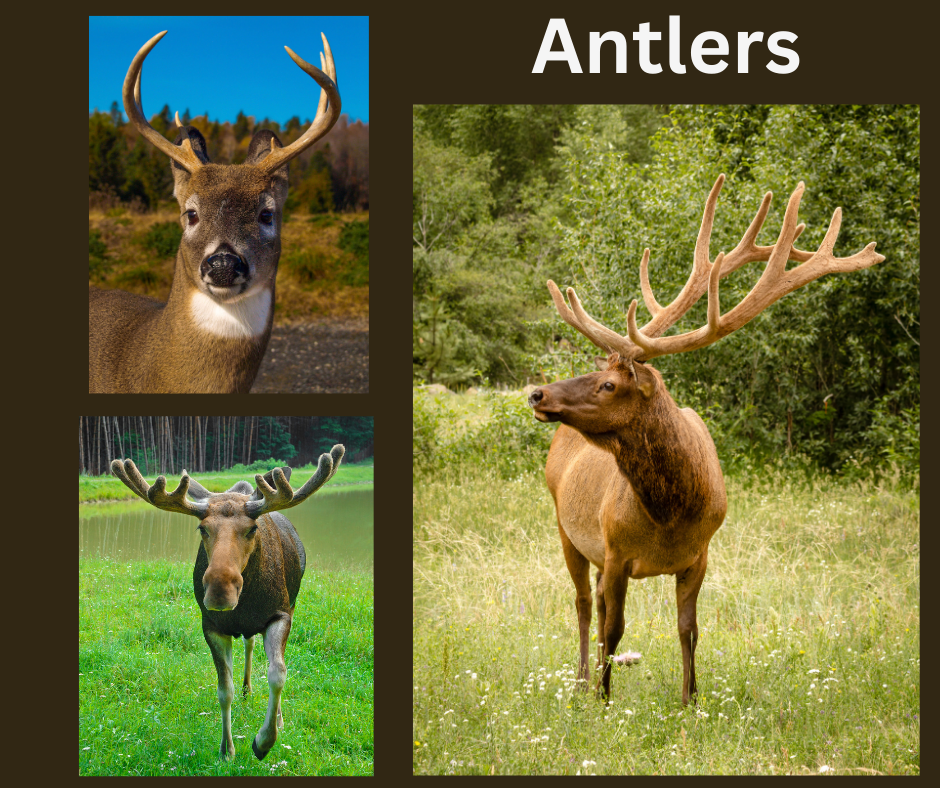
The primary differences between deer, elk, and moose lie in their size, appearance, habitat, and behavior. While all three are part of the Cervidae family (the deer family), they have distinct characteristics that set them apart.
In this article we will explore their similarities and differences. I have complete articles on each species if you want a deep dive!
Antlers
Members of the Cervidae have antlers. Antlers are living bone that grows rapidly and are shed each year.
1. Size
Deer: The smallest of the three. White-tailed deer and mule deer, which are the most common species in North America, typically weigh between 100 to 300 pounds and stand about 2.5 to 3.5 feet tall at the shoulder.
Elk: Larger than deer but smaller than moose. Elk are much heavier, with males (bulls) weighing between 600 to 1,100 pounds and standing around 4.5 to 5 feet tall at the shoulder.
Moose: The largest member of the deer family. Moose can weigh up to 1,500 pounds (with some bulls exceeding 1,800 pounds) and stand 5 to 7 feet tall at the shoulder, making them massive animals compared to elk and deer.
2. Antlers
Deer: Deer antlers are relatively small and often branched, with a more compact and symmetrical appearance. They are shed and regrown annually by male deer.
Elk: Elk antlers are larger than those of deer and branch out in a more vertical and sweeping pattern. They can grow up to 4 feet long in mature bulls and are used during the rut for fighting other males.
Moose: Moose antlers are the most distinct, with a broad, palmate shape (like the shape of an open hand or fan). They can span up to 6 feet across and are much heavier and more solid than elk or deer antlers.
Moose are huge herbivores that live in cold climates. In this video I share 10+ fun facts and trivia about moose and what makes them cool!
3. Habitat
Deer: Deer are incredibly adaptable and live in a variety of habitats across North America, including forests, grasslands, farmlands, and even suburban areas.
Elk: Elk prefer more open habitats, such as grasslands, meadows, and mountainous regions. They are often found in forested areas at higher elevations in the summer and lower areas in the winter.
Moose: Moose are primarily found in northern, colder climates, including the forests and wetlands of Canada, Alaska, northern Europe, and northern states like Maine, Minnesota, and Montana. They thrive in areas with abundant water, such as swamps, lakes, and rivers.
4. Coloration
Deer: White-tailed deer have a reddish-brown coat in summer, which turns to grayish-brown in winter. Mule deer have a similar coloration but are generally a bit darker with a more grayish tone year-round.
Elk: Elk have a tan to reddish-brown body with a darker brown mane around their neck and a light-colored rump. Their coat also becomes more subdued and grayish-brown in winter.
Moose: Moose have dark brown or black coats year-round. They often appear almost black, especially in winter, which helps them blend into their forested, shadowy habitats.
5. Vocalizations
Deer: Deer tend to be quieter, though they may make soft grunting sounds or snorts, particularly when alarmed.
Elk: Elk are famous for their bugling during the rut, which is a loud, high-pitched call that can be heard over long distances.
Moose: Moose are usually quiet but can make loud grunts during the rut, and cows may produce soft moans when calling to their calves.
Learn more about the bull elks quest to find a female, raising calves, and why antlers are so cool.
6. Social Behavior
Deer: Deer are more solitary or form small family groups, particularly females with fawns. Bucks (males) are more solitary outside the mating season.
Elk: Elk are social animals that live in herds, often in large groups during the winter. They exhibit strong social behavior, especially during the rut when bulls compete for dominance.
Moose: Moose are typically solitary creatures, except for cows with calves. They are known to be more aggressive during the rut, and because of their size, they are not easily intimidated by predators.
Everything you want to know about white-tailed deer including how they raise their young, rehabilitation needs, what's the deal with antlers, population, and keeping them out of the garden.
7. Diet
Deer: Deer are browsers, feeding on a variety of shrubs, leaves, grasses, and sometimes even crops.
Elk: Elk are both grazers and browsers, feeding on grasses, forbs, shrubs, and tree bark, depending on the season.
Moose: Moose are selective browsers, feeding heavily on aquatic vegetation, willow, and other woody plants. They are often seen wading in water to eat submerged plants.
8. Geographic Range
Deer: Deer are widespread across North America, with white-tailed deer covering most of the U.S. and parts of Canada, and mule deer inhabiting western North America.
Elk: Elk are mostly found in the western U.S. and Canada, with smaller populations in the eastern U.S. due to reintroduction efforts.
Moose: Moose are found in northern regions, including Canada, Alaska, the northern U.S., Scandinavia, and Russia.
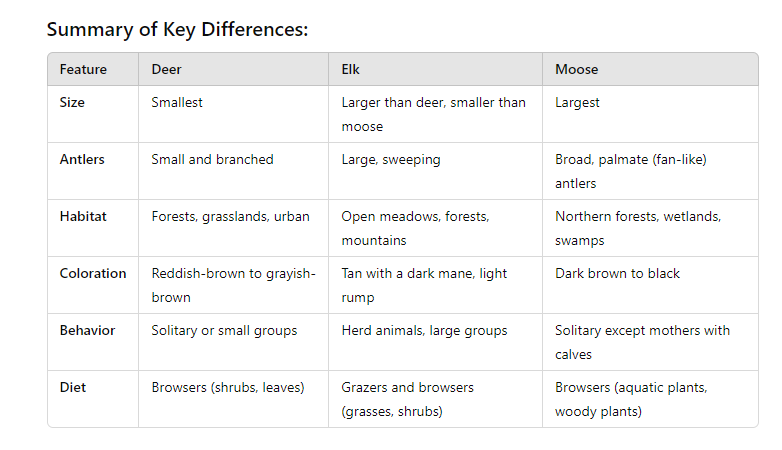
Comparison Chart of Key Differences

Check out my books on Amazon.
Author, Ame Vanorio, is the founder of Fox Run EEC, a Master Gardener, Environmental Educator, Wildlife Rehabilitator and Writer. You can check out my Amazon Storefront to see the products I personally use and recommend.

Elk (Cervus canadensis) are one of the largest species of deer in the world. Their majestic presence and significant role in the ecosystem make them fascinating creatures. In this blog post, I will answer your elk questions. We will explore the biology, habitat, behavior, and conservation of these magnificent animals.