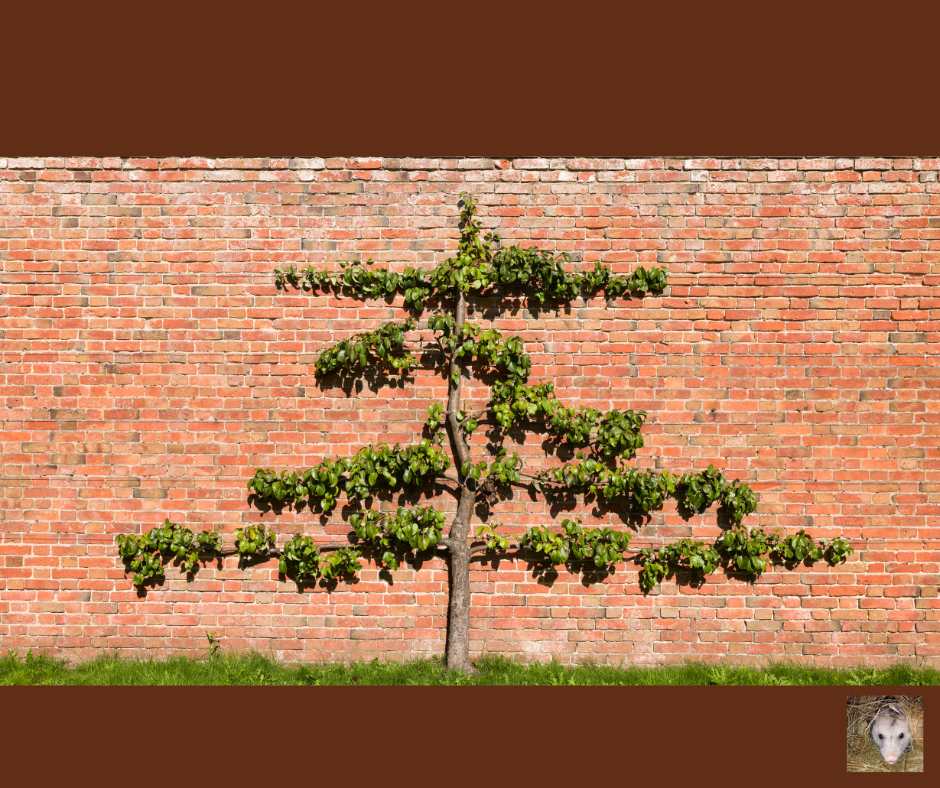
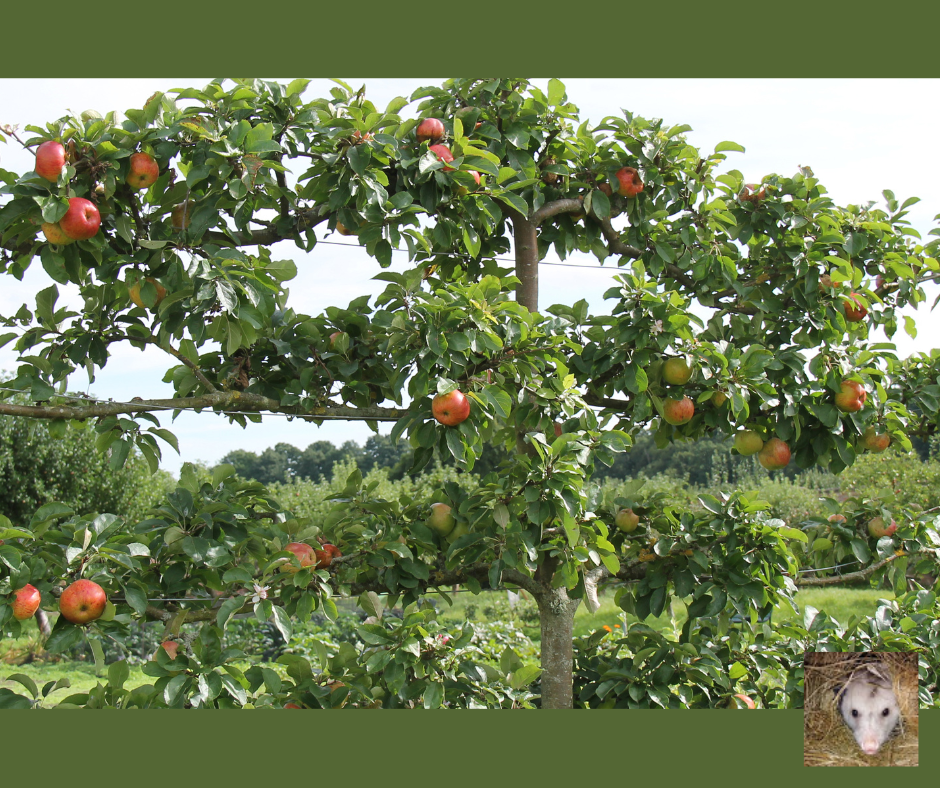
Espalier fruit trees are not only a beautiful addition to any garden but also a practical way to grow fruit in a limited space. Espalier is a way of training fruit trees to grow flat against a wall, fence, or trellis. Instead of a wide, spreading tree, you guide the branches into a single plane.
This technique has been used for centuries in Europe and is still one of the best options for small yards and urban gardens. Espalier's saves space, increases light exposure, and makes fruit easier to manage and harvest.
It does take planning and regular pruning to grow espaliers, but the results are worth it. There are several ways to grow them. Up against a wall or free standing. Free standing forms are often attached to wires and used as fencing or defining the edges of your garden.
In this article I will explain how to plant an espalier, choose a good variety, and I will walk you through two pruning methods.
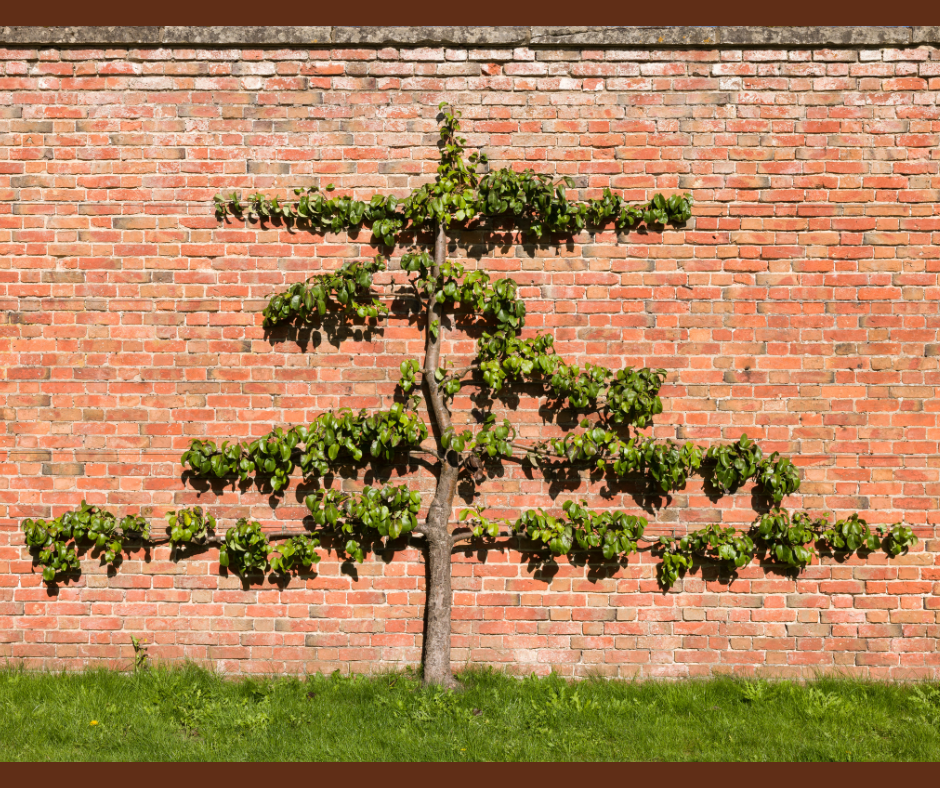
The French word espalier means to rest against something. Many people grow them against a wall, building or fence. The term can be pronounced “es-PAL-yer” or “es-PAL-yay”.
Pros of Growing Espalier Fruit Trees
Espalier trees take up very little space, making them ideal for patios, courtyards, and narrow yards. They allow people to grow fruit where traditional trees would never fit.
Fruit quality often improves because sunlight reaches leaves and fruit evenly. This leads to better color, flavor, and ripening.
Maintenance and harvesting are easier because the tree stays accessible. Most pruning and picking can be done from the ground. A great option if you are “older” or have joint issues.
Espalier adds structure and beauty to the garden. A fruiting wall or fence can serve as both food source and landscape feature.
Cons and Challenges to Consider
Espalier requires planning and patience. It takes several years to establish a full structure and consistent harvest.
Pruning is ongoing. If neglected, espalier trees quickly lose shape and productivity. This is not a plant-it-and-forget-it system.
Initial setup costs can be higher due to trellises, wires, and quality trees. However, these are long-term investments.
Mistakes early on can be hard to correct later. Proper training from the first year is critical.
Check out my book on growing fruit!
Selecting the Site
First consider your location. Espalier fruit trees require a sunny location with good air circulation. Choose a spot against a wall, fence, or building that receives at least 6-8 hours of sunlight per day. These trees depend on good light and airflow since their growth is confined.
Airflow matters. While walls provide warmth, stagnant air increases disease pressure. Avoid tight corners where air does not move. A fence with gaps or a freestanding trellis often provides better airflow than a solid wall. Wind exposure should be moderate. Strong winds can damage trained branches, especially when trees are young.
A south- or west-facing wall is ideal in cooler climates because it reflects heat and helps fruit ripen. In hotter regions, an east-facing wall works well and reduces heat stress during the afternoon.
Planting
Soil drainage is critical. Espalier trees are long-term plantings, so they should never sit in wet soil. Choose a location where water drains well, or amend the soil before planting with compost to improve structure. Raised beds can work if they are deep enough to support roots. Keep in mind soil next to foundations may be of poor quality.
Even though they are dwarf trees they should be planted 10-12 feet apart. This is because you will be training the branches to a horizontal or semi-horizontal shape. when you plant a tree traditionally you think about its space as a circle. Here we think about linear space.
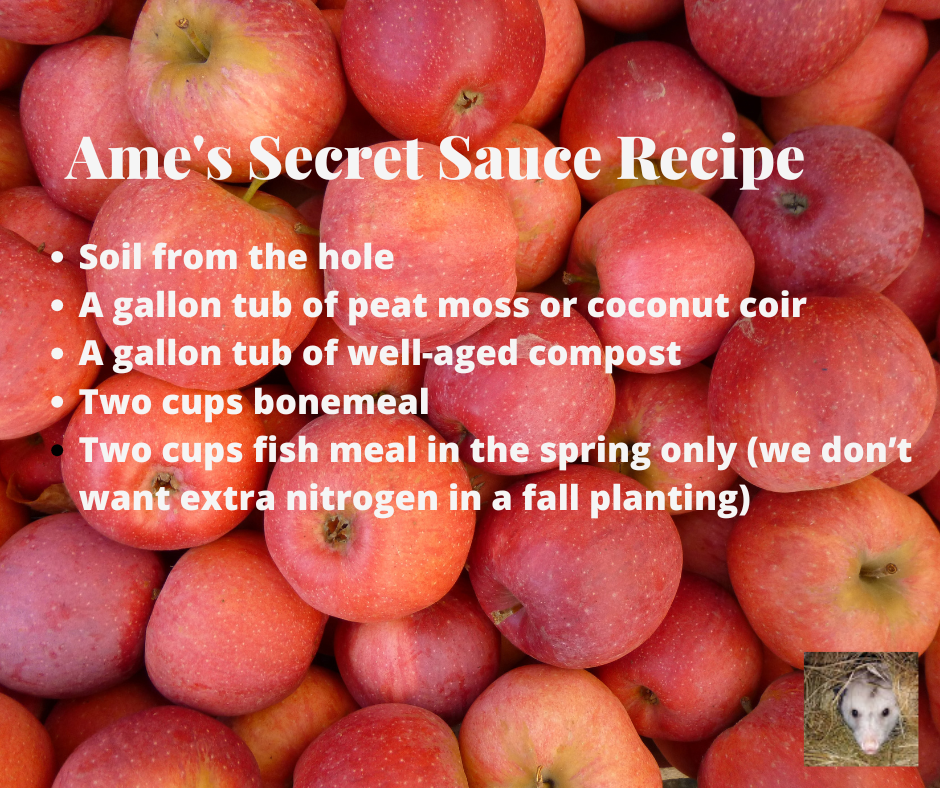
I’ve come up with a fabulous formula for planting my fruit trees. This will produce a soil that is light, holds moisture, and provides nutrients.
Build Your Soil
I’ve come up with a fabulous formula for planting my fruit trees. Ame’s Secret Sauce Recipe
This will produce a soil that is light, holds moisture, and provides nutrients.
Mix together:
Soil from the hole
A gallon tub of peat moss or the more sustainable choice of coconut coir
A gallon tub of well-aged compost
Two cups bonemeal
Two cups fish meal in the spring only (we don’t want extra nitrogen in a fall planting)
While this method takes more time than digging a hole and sticking in a tree, it will get young tree off to a great start, and pay off huge dividends in the long run.
Vegan Options
If you are vegan or want to avoid animal products in your garden, Alfalfa Meal and Cotton Seed Meal are great replacements for fish meal.
Alfalfa is a fabulous source of nitrogen and organic alfalfa meal is widely available. In addition, alfalfa makes a good cover crop. Alfalfa meal is great to add to the soil when planting a young tree.
Down to Earth also features a Vegan Fertilizer which is a mix of Organic Soybean Meal, Neem Seed Meal, Alfalfa Meal, Rock Phosphate, Langbeinite, Greensand, Humates and Kelp Meal.
You can read my article Vegan Composting and Fertilization
Moisture
Water the tree well its first year. It will need about an inch of rain or about two gallons of water each week for a young tree. Make sure to water the soil not the tree.
A good mulch around the base of the tree will help keep moisture in.
Fertilizing and Watering
Espalier fruit trees benefit from regular fertilization to support healthy growth and fruit production. Mulch with 2 inches of aged compost in the spring. Foliar feed with fish emulsion and seaweed.
To learn about my fruit maintenance schedule, check out my video below and there is a Free Download on the Resources Page.
Here's a look at my spray and maintenance schedule for fruit trees. It's important to keep on top of pests and diseases in the orchard.
Build The Framework
An espalier tree needs a framework, so you have something to attach the tree to. Once you plant the tree it will be hard to work behind it so do this first. Also you don’t want to break any branches trying to slide your body around the tree.
Before planting, decide on the shape you want. The shape determines how you prune and train the tree from the first year forward. Before you plant you also need to decide how you will attach and train the tree. Install your support system at planting.
This may be wires attached to a wall, a trellis, or tensioned fence wire. Supports should be strong enough to last decades. If you are attaching your tree to a stone or brick wall you need to decide how it will attach. You can build a frame next to the wall or attach wires to the wall.
To attach wire to a brick wall for espalier, you will need to drill holes, insert rawlplugs or something similar, and screw in long-shanked eye hooks or vine eyes. That way the branches are not crawling up the wall - we don’t want the ivy effect. Then string galvanized 8 - 10 gauge wire between them, using turnbuckles for tension and securing ends with crimps or twists. If you are building a fence for the frame use 4x4s so that it will be strong and sturdy.
Start by installing horizontal wires spaced about 18 - 20 inches apart. You will be training the tree and attaching branches to this framework.
Choosing the Right Fruit Tree
You will need to select the right type of fruit tree for espalier training. Apple and pears work well. Choose a healthy, young tree with flexible branches that can be easily trained into the desired shape.
Spur-bearing fruit trees such as pears and apples are well-suited for espalier training due to their natural growth habit. These trees produce fruit on short lateral branches known as spurs, which develop close to the main trunk. Spurs are the short stubby clusters of tiny branches. When trained using the espalier technique, spur-bearing trees can be easily manipulated to grow along a flat surface such as a trellis or wall.
Spur-bearing fruits often have a higher fruit yield in a smaller space compared to other fruit tree types, making them a practical choice for those looking to maximize fruit production in a small space.
To learn more about growing them traditionally read Growing Apples
Plums, apricots and peaches are doable and they enjoy the warmth of a wall. But they require more management so are best for someone with some experience under their belt. Stone fruits tend to fruit on younger wood and do not tolerate heavy pruning as well. These trees are best for fan shapes rather than horizontal.
Rootstock
Dwarf cultivars are easier to train than standard size trees. Rootstock choice matters. They control tree size and make long-term training manageable. A rootstock is the root system and lower trunk of a grafted plant, serving as the foundation onto which a desired variety (the scion) is attached
In addition, when choosing an espalier tree look at what rootstock it is on as this keeps the tree smaller. Dwarf pear trees are often grafted on quinces. Look for Quince A or Quince C rootstock.
For a smaller dwarf apple tree Bud 9 or M9 are best. Dwarf pear trees are grafted on quinces. Look for Quince A or Quince C rootstock. If you are looking for something a bit taller M27 or G16 are good ones to look for. Reputable nurseries will know what their fruit trees are grafted on.
Best Varieties For Espalier
Consider pollination of your trees. Are they self pollinating or need to cross pollinate? This is important to consider because you may only have room for one or two trees.
Some varieties like Golden delicious are considered self pollinating and do well with pruning. Classic varieties like Cox orange pippin are great for espalier shaping but do need a pollination friend. Both of these trees also fruit on spurs.
Some other apples that do well using horizontal espalier are Enterprise, Liberty, and Williams Pride.
If you are using a fan shape Gala, Granny Smith, and Jonagold apples are good choices.
For pears, the European varieties do better. Bartlett, Bosc, Kieffer, and Moonglow do well grown as espaliers.
Training the Tree
To train a fruit tree into an espalier shape, you'll need to start by pruning and shaping the branches. Consider your tree species and adjust your pruning techniques accordingly to achieve the desired espalier shape. Plant bare-root trees whenever possible. They establish faster and are easier to train from the beginning.
Regular pruning is essential to maintain the shape of the espalier fruit tree and promote fruit production. Prune the tree in late winter or early spring to remove any dead, damaged, or crossing branches. Time your cuts. For example if a stem is pruned back to just above a bud in winter, it will force vigorous new growth in spring. If, however, a stem is pruned back in summer, it will become a spur that will produce fruit.
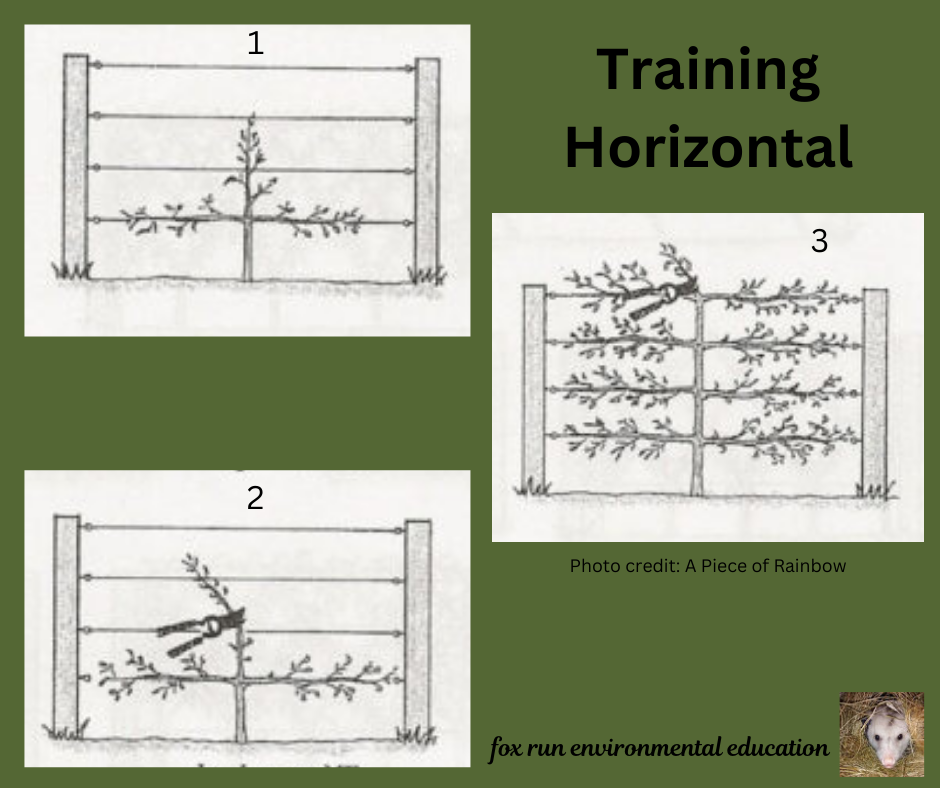
Horizontal
Horizontal is the most common style. It has a central vertical trunk with horizontal branches trained at regular intervals. This form works well for apples and pears and is easy to maintain.
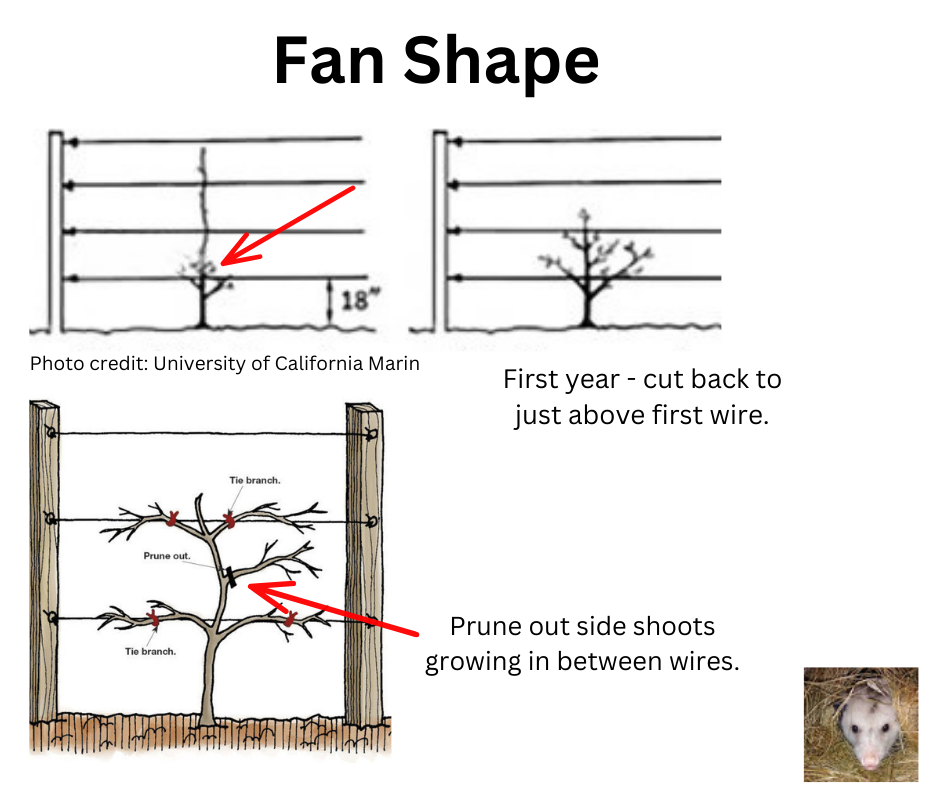
When the trees are planted, cut them back to about 2 or 3 inches above the first wire. Use garden ties or training wires to secure the branches to the supporting structure as they grow. This encourages side shoots to form at the right level. Training espalier is about guiding growth early, not forcing it later. Allow it to grow that first summer. In fall choose the two best side branches and tie them to the wire. Allow the vertical stem to grow until it reaches the next wire. Prune out side shoots growing in between wires.
Fan
The other popular and beginner friendly design is the fan. Fan espalier spreads branches outward like a fan from a low trunk. This style is best for stone fruits and figs because it allows for regular renewal of fruiting wood. Regular pruning is essential to maintain the shape of the espalier fruit tree and promote fruit production. Prune the tree in late winter or early spring to remove any dead, damaged, or crossing branches.
Choose several branches to serve as the main limbs of the fan shape, radiating outward from the trunk. Secure main limbs to a support structure in a fan-like pattern, ensuring an open, evenly spaced arrangement. Prune any additional growth not aligned with the desired fan shape.
Begin by selecting the central leader and the main horizontal branches that will form the desired pattern, such as a cordon, fan, or candelabra. Use garden ties or training wires to secure the branches to the supporting structure as they grow.
Pruning and Maintenance
Espalier training happens over several years. The goal is slow, steady structure building rather than fast growth.
As new shoots grow, select the strongest ones for your framework. Tie them gently to the support using soft ties that do not cut into bark. Never force branches into position. Bend them gradually over weeks.
Remove unwanted vertical shoots early. This keeps energy focused on the branches you want to keep. Summer pruning is especially helpful for controlling growth.
Once the main structure is set, focus on developing fruiting spurs. These short shoots form along trained branches and produce flowers and fruit year after year.
Harvesting the Fruit
As your tree matures, it will begin to produce fruit along its trained branches. Harvest the fruit when it is ripe and enjoy the unique beauty and flavor of homegrown espalier fruits.
Remember, patience and dedication are key when growing espalier fruit trees, so take your time and enjoy the process of shaping nature into a work of art in your own backyard.
Author, Ame Vanorio, is the founder of Fox Run EEC, an organic gardener, and author.

Sometimes we get so caught up in gardening out in the sun that we forget that many fruits are native to woodland areas. Native fruits are often shade tolerant and will produce fruits in 4-6 hours of sun a day.
These 9 fruits will give you great yield in shade and are quite hardy.